Golden Retriever
Golden Retriever: does it suit you?
11 quick questions, the same ones this page answers. After each answer you see what the breed needs, and at the end whether it fits your life.

Golden Retriever: a good fit for you
Golden Retriever: could work, with compromises
Golden Retriever: probably not the right dog for you
Your answers match what the breed needs.
Most of your answers fit. Check the points below before you decide.
Some of your answers don't fit what the breed needs. The points below show where.
What to think about
What fits
A better match for your answers:
None of the 42 breeds on this site fits your answers better.
Bred in the 19th century as a gundog for an estate in the Scottish Highlands, the Golden Retriever is today a serious worker at hunting and field work, as a guide for the blind and in search-and-rescue, and also enjoys obedience and other competitive events.[1] The breed standard calls it biddable, intelligent, kindly and confident, with natural working ability.[2]
- Size
- Large
- Weight
- 25–34 kg
- Life expectancy
- 10–12 years
Golden Retriever: origin and history
The first Lord Tweedmouth is credited as the founder of the breed, starting with a yellow dog bred from black Wavy Coated Retrievers crossed with the Tweed Water Spaniel.[3] For fifty years, from 1840 to 1890, he kept scrupulous records of the breedings he made to create an ideal gundog for his Guisachan estate in Inverness-shire.[1]
In 1913 The Kennel Club recognised the breed as a ‘yellow’ or ‘golden’ Retriever, and the official name became Golden Retriever when the Golden Retriever Club was established in 1920.[3] Definitive FCI acceptance followed on 2 December 1954.[4] The FCI standard gives Great Britain as the country of origin and places the breed in Group 8 (Retrievers – Flushing Dogs – Water Dogs), Section 1 (Retrievers), with working trial.[2]
Fact sheet
Character and needs
Rated on a scale from very low to very high.
- Exercise needshigh
- Trainabilityvery high
- Grooming needsmoderate
- Sheddinghigh
- Barkinglow
- Good with kidsvery high
- Good with other dogsvery high
- Good with catshigh
- Apartment-friendlylow
- Copes with being alonelow
- Watchdog instinctvery low
- Good for first-time ownersvery high
- Affectionvery high
Golden Retriever: questions and answers
Is it a good dog for first-time owners?
Yes. It rates 5 out of 5 for first-time owners. These dogs learn quickly and like working with you (5 out of 5 for trainability).
How long can it be left alone?
2 to 3 hours, once the dog is an adult and has learned to be alone step by step. These dogs are very attached to their people and often struggle on their own (2 out of 5 for coping alone). More than 6 hours at a stretch isn't fair on any dog; plan for a dog sitter or daycare. Puppies need company: start with a few minutes and build up.
How much exercise does it need?
About 2 hours a day, spread over several walks. Plan for off-lead running or games, not just walks on the lead. Until the dog is fully grown, keep walks short and avoid jumping to protect the growing joints.
How long does it live?
10–12 years is the typical life expectancy. That is shorter than the average of the 42 breeds on this site (12.6 years). As with most large breeds, life is shorter than for small dogs. Breed-typical health risks: hip dysplasia, elbow dysplasia, cancer, skin allergies, eye disease, heart disease.
How big does it get?
51–61 cm at the withers and 25–34 kg. Size class: large.
Is it a good family dog?
Yes. It rates 5 out of 5 with children. Its size and energy can knock over small children, so supervise play. With other dogs it rates 5 out of 5, with cats 4 out of 5. Never leave young children alone with any dog.
Does it shed a lot?
Yes, a lot: 4 out of 5 for shedding. Expect hair on clothes, sofa and car all year round. Brush two or three times a week.
Male or female?
56–61 cm at the withers for males and 51–56 cm for females, according to the breed standard. Weight: 29–34 kg for males and 25–29 kg for females. Character differences between the sexes are smaller than between individual dogs; upbringing matters more. Unspayed females come into heat about twice a year, and unneutered males can be restless around them.
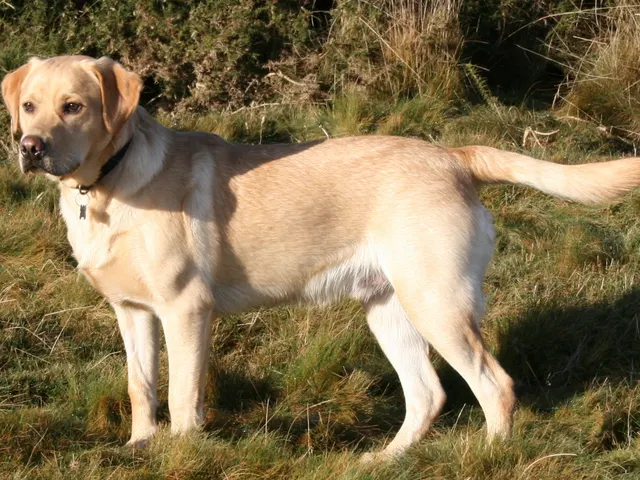
Golden Retriever or Labrador Retriever?
Biggest difference: grooming needs (moderate vs. low).
| Golden Retriever | Labrador Retriever | |
|---|---|---|
| Size | Large | Large |
| Weight | 25–34 kg | 25–36 kg |
| Life expectancy | 10–12 years | 10–12 years |
| Coat | Long | Short |
| Grooming needs | Moderate | Low |
Who it suits
A good fit if you…
- love being outdoors and have 2 hours or more a day for exercise
- are getting your first dog
- have children
- have a cat
- want a quiet dog
- want to do dog sports such as agility or obedience
- want a cuddly companion
Golden Retriever: the downsides
Every breed has a flip side. Before you decide, check that you can live with these:
- Needs about 2 hours of exercise a day
- Every day, in any weather, for 10–12 years. Without enough exercise and things to do, the dog gets restless and may start chewing or barking.
- Struggles when left alone
- 2 to 3 hours at most. If you work away from home, plan for a dog sitter or daycare from the start.
- Sheds heavily
- 4 out of 5 for shedding. Expect hair on clothes, sofa and car all year round.
- Needs space
- 2 out of 5 for apartment living. The dog does best in a house with a garden or with fields on the doorstep.
- Breed-typical health risks
- Hip dysplasia, elbow dysplasia, cancer, skin allergies, eye disease, heart disease. Choose a breeder who screens the parents, and consider health insurance.
Golden Retriever: puppy price and monthly costs
£1,000 – £3,000 for a puppy from a breeder in the UK (Agria Pet Insurance, 2026). From £116 a month in running costs in the UK (PDSA, 2024). Covers food, vet visits, insurance, other costs.
| Country | Puppy from a breeder | Running costs per month |
|---|---|---|
| United Kingdom | £1,000 – £3,000 [6] | from £116 [7] |
| United States | $1,000 – $3,500 [8] | $116 [9] |
| Canada | CA$1,200–4,000 [10] | CA$367 [11] |
| Australia | A$4,000–6,000 [12] | A$210 [13] |
| New Zealand | NZ$1,500–2,500 [14] | NZ$100 [15] |
- Set-up costs at the start: £415 – £560 for basic equipment, first vaccinations, wormers and neutering (PDSA, 2024).
- Dog licence in Northern Ireland: £12.50 a year; England, Scotland and Wales have none (nidirect, 2026).
- Dog licence in the US: $5 – $20 a year, set by the city or county (American Kennel Club, 2021).
- Dog licence in Canada: CA$25–60 a year in Toronto, less for a neutered dog (City of Toronto, 2026).
- Dog registration with the council in Australia: A$20–200 a year, depending on the council and whether the dog is desexed (Mozo, 2026).
- Dog registration with the council in New Zealand: NZ$78–182 a year in Auckland, depending on the dog (PetMall NZ, citing Auckland Council, 2026).
- Puppies far below these prices often come without health checks or papers.
Health
Breed-typical health risks
- Hip dysplasia [21]
- A malformed hip joint. Both parents should be X-ray screened.
- Elbow dysplasia [21]
- A malformed elbow joint that can cause lameness.
- Cancer [21]
- A higher tumour risk, especially with age.
- Skin allergies [22]
- Prone to itching and skin inflammation.
- Eye disease [3]
- Inherited conditions such as PRA or cataracts. Good breeders have the eyes tested.
- Heart disease [21]
- Breed-typical heart conditions. Regular heart checks are sensible.
Health tests for the parent dogs
12 health tests appear in the breeding rules for the breed.
- No health test is required for breeding in the UK (The Royal Kennel Club); the table shows what is recommended.
- Needed for a CHIC number in the US (Orthopedic Foundation for Animals): hip X-ray (HD), elbow X-ray (ED), eye exam, and heart exam.
- No health test is required for breeding in Canada (Golden Retriever Club of Canada); the table shows what is recommended.
- Required for breeding in Australia (Dogs Australia): hip X-ray (HD), elbow X-ray (ED), and eye exam. Required of club members who breed in Australia (Dogs Australia): heart exam and DNA tests (GR-PRA1, GR-PRA2).
- Required of club members who breed in New Zealand (The Golden Retriever Club Inc.): hip X-ray (HD), elbow X-ray (ED), and eye exam.
| Test | United Kingdom [3] | United States [23] | Canada [24] | Australia [25] | New Zealand [26] |
|---|---|---|---|---|---|
| Hip X-ray (HD)Hip dysplasia | Recommended | Required | Recommended | Required | Required |
| Elbow X-ray (ED)Elbow dysplasia | Recommended | Required | Recommended | Required | Required |
| Eye examInherited eye disease, by a certified vet ophthalmologist | Recommended | Required | Recommended | Required | Required |
| GonioscopyGlaucoma risk | Recommended | not in the rules | not in the rules | not in the rules | not in the rules |
| Heart examInherited heart disease, by a cardiologist | not in the rules | Required | Recommended | Required [27] | not in the rules |
| DNA test: DMDegenerative myelopathy | not in the rules | not in the rules | Recommended | not in the rules | not in the rules |
| DNA test: GR-PRA1Progressive retinal atrophy | Recommended | not in the rules | Recommended | Required [27] | not in the rules |
| DNA test: GR-PRA2Progressive retinal atrophy | Recommended | not in the rules | Recommended | Required [27] | not in the rules |
| DNA test: ICTIchthyosis (scaly skin) | not in the rules | not in the rules | Recommended | not in the rules | not in the rules |
| DNA test: ICT-AIchthyosis (scaly skin) | Recommended | not in the rules | not in the rules | not in the rules | not in the rules |
| DNA test: NCL5Neuronal ceroid lipofuscinosis | not in the rules | not in the rules | Recommended | not in the rules | not in the rules |
| DNA test: prcd-PRAProgressive retinal atrophy | not in the rules | not in the rules | Recommended | not in the rules | not in the rules |
● Required. ○ Recommended: advised, not required. – Not in the rules. The clubs and their rules are in the source list.
United Kingdom: the Royal Kennel Club’s Health Standard requires no test, so every test is ○ recommended.
United States: ● means the test is needed for a CHIC number from the OFA; taking part in CHIC is voluntary.
Canada and New Zealand: ● means the breed club’s code of ethics requires the test of member breeders; the kennel club registers litters without it.
Australia: ● means a litter is only registered if the parents have the test.
What to ask the breeder
- Certificates for both parents: hip X-ray (HD), elbow X-ray (ED), eye exam, and heart exam. A claim that the parents are “health tested” is not enough.
- DNA results of both parents for GR-PRA1 and GR-PRA2, or proof that both are clear by descent.
- To see the puppies with their mother, at the breeder’s home.
- The pedigree papers (United Kingdom: Royal Kennel Club registration certificate; Canada: CKC certificate of registration; Australia: Dogs Australia pedigree, issued by the state body; New Zealand: Dogs NZ certificate of registration). [28] [29] [30] [31]
- 8 weeks: the youngest age at which a puppy may leave its mother in the UK, in Canada (Quebec), and in Australia (New South Wales). [32] [33] [34]
- Advice on buying a puppy: The Royal Kennel Club, The Canadian Kennel Club, Dogs Australia, and Dogs New Zealand. [35] [36] [37] [38]
Similar breeds



Sources
- American Kennel Club: Golden Retriever Dog Breed Information
- FCI (Fédération Cynologique Internationale): Breed standard No. 111: Golden Retriever (2026)
- The Royal Kennel Club: Retriever (Golden) | Breeds A to Z
- FCI (Fédération Cynologique Internationale): Golden Retriever (FCI nomenclature)
- American Kennel Club (AKC): Official breed standard: Golden Retriever (1981)
- Agria Pet Insurance (UK): Golden Retriever Pet Insurance - The UK's Most Trusted Pet Insurer (2026)
- PDSA (People's Dispensary for Sick Animals, UK veterinary charity): The cost of owning a dog (2024). Covers food, vet visits, insurance, other costs.
- PetMD: Golden Retriever Dog Breed Health and Care (2024)
- ASPCA (American Society for the Prevention of Cruelty to Animals): Cutting Pet Care Costs (2021). Covers food, vet visits, preventive medicine, insurance, toys and treats, boarding, dog licence, grooming supplies.
- Furkin (Canadian pet insurer): Everything You Need to Know about Golden Retrievers! (2026)
- Pets Plus Us (Canadian pet insurer; figures from OVMA 2024 Cost of Care research): HOW MUCH IS THAT DOGGY? (EN-DOG_PPU_Cost-of-Care_Aug2024_v3.pdf) (2024). Covers food, vet visits, insurance, dog tax, accessories.
- Knose (pet insurer): Knose Golden Retriever breed page (2026)
- Animal Medicines Australia (survey by Sweeney Research/SNR): Pets in Australia: A national survey of pets and people (Pet Ownership Study 2025) (2025). Covers food, vet visits, insurance, parasite treatment, vet medicines, supplements, grooming, training, accessories, dog walking, boarding, transport, memberships, alternative healthcare.
- Pet-n-Sur: Understanding dog prices: what does it really cost to get a dog? (2025)
- Companion Animals New Zealand (NZ Companion Animal Council): Companion Animals in New Zealand 2016 (section 6.3 Dogs, Fig 50) (2016). Covers food, vet visits, dog tax, boarding, equipment, grooming, healthcare products, insurance, training, other costs.
- nidirect (official government website for Northern Ireland): Dog licensing and microchipping (2026)
- American Kennel Club: Are You Financially Prepared for a Puppy? Explore Costs of Owning a Dog (2021)
- City of Toronto: Pet Licensing Fees (2026)
- Mozo: How much does it cost to own a dog or cat in Australia? 2026 (2026)
- PetMall NZ, citing Auckland Council: Auckland Dog Registration 2026–27: Late Fees Now Apply — Full Fee Table (2026)
- Golden Retriever Club of America, Health and Genetics Committee: The GRCA Electronic Health Survey at 1 Year: Data on Longevity and Cancer (2012)
- Veterinary Medicine: Research and Reports (Drechsler Y. et al.): Canine Atopic Dermatitis: Prevalence, Impact, and Management Strategies (2024)
- Orthopedic Foundation for Animals (OFA): CHIC Program Requirements: Golden Retriever
- Golden Retriever Club of Canada: Code of Ethics (2023)
- Dogs Australia (Australian National Kennel Council Ltd): Regulations Part 6: The Register and Registration (Section 8 Breeding, incl. breed-specific Litter Registration Limitations 8.8-8.18) (2026)
- The Golden Retriever Club Inc. (New Zealand): Members' Code of Ethics
- Golden Retriever Club of Victoria Inc. (GRCV): Code of Ethics (section 'Hereditary Defects, Health & Breeding')
- The Royal Kennel Club: What should the breeder give me?
- The Canadian Kennel Club: By-Laws (incl. Code of Ethics (2025)
- Dogs Australia: Getting a Dog: Importance of Pedigree Papers
- Dogs New Zealand (New Zealand Kennel Club Inc.): Registration Regulations (Section 4, Reg. 24: Litter Registration Limitations (2026)
- UK Government (legislation.gov.uk): The Animal Welfare (Licensing of Activities Involving Animals) (England) Regulations 2018 (S.I. 2018/486), Schedule 6 (breeding dogs) and Schedule 3 (selling animals as pets) (2018)
- Ministère de l'Agriculture, des Pêcheries et de l'Alimentation du Québec (MAPAQ): Guide d'application du Règlement sur le bien-être et la sécurité des animaux domestiques de compagnie et des équidés (reproduces CQLR c. B-3.1, r. 0.1, art. 36) (2023)
- NSW Department of Primary Industries and Regional Development (DPIRD), State of New South Wales (fact sheet hosted by Dogs NSW): New laws for dog breeders in NSW (fact sheet on the 2024-25 amendments to the Prevention of Cruelty to Animals Act 1979 and Companion Animals Act 1998) (2025)
- The Royal Kennel Club: Questions for the breeder
- The Canadian Kennel Club: Finding an Accountable Breeder
- Dogs Australia: Getting a Dog: Choosing a Breeder
- Dogs New Zealand: How do you go about purchasing a pedigree pure bred dog?
Breeding rules, health sources and breed standards checked October 8, 2026.
Prices as published by the sources; collected October 8, 2026.
Breed traits describe typical tendencies. Every dog is an individual, shaped by genes, upbringing and training.