French Bulldog
Frenchie
French Bulldog: does it suit you?
11 quick questions, the same ones this page answers. After each answer you see what the breed needs, and at the end whether it fits your life.
French Bulldog: a good fit for you
French Bulldog: could work, with compromises
French Bulldog: probably not the right dog for you
Your answers match what the breed needs.
Most of your answers fit. Check the points below before you decide.
Some of your answers don't fit what the breed needs. The points below show where.
What to think about
What fits
A better match for your answers:
None of the 42 breeds on this site fits your answers better.
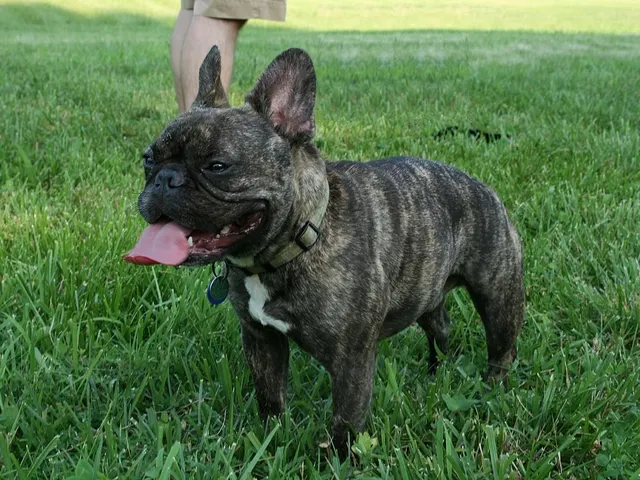
The French Bulldog comes from Paris, where in the 1880s it was the dog of market porters, butchers and coachmen before its appearance and character won over high society and the art world.[1] It is kept as a companion dog, and its standard calls it sociable, lively and playful.[1] The short muzzle can cause breathing problems; more on this under Health.[2]
- Size
- Small
- Weight
- 8–14 kg
- Life expectancy
- 10–12 years
French Bulldog: origin and history
Like all mastiffs, the breed probably descends from the molossers of Epirus and the Roman Empire, and it is related to the Bulldog of Great Britain.[1] The Royal Kennel Club also tells of a British strand in its ancestry: lace makers from Nottingham, threatened with redundancy in the Industrial Revolution, emigrated to northern France and took their dogs with them.[3] The French Bulldog as it is known today is the product of crosses made by enthusiastic breeders in the working-class quarters of Paris in the 1880s.[1]
The first breed club was founded in Paris in 1880, and the first standard was drawn up in 1898, the year the French Kennel Club recognised the breed.[1] Its definitive acceptance by the FCI dates from 30 November 1954.[4] It belongs to FCI Group 9 (Companion and Toy Dogs), Section 11 (Small Molossian type Dogs).[1]
Fact sheet
Character and needs
Rated on a scale from very low to very high.
- Exercise needslow
- Trainabilitymoderate
- Grooming needsvery low
- Sheddinglow
- Barkingvery low
- Good with kidshigh
- Good with other dogsmoderate
- Good with catsmoderate
- Apartment-friendlyvery high
- Copes with being alonemoderate
- Watchdog instinctlow
- Good for first-time ownershigh
- Affectionvery high
French Bulldog: questions and answers
Is it a good dog for first-time owners?
Yes. It rates 4 out of 5 for first-time owners. Training takes patience and consistency (3 out of 5 for trainability).
How long can it be left alone?
Up to 4 hours, once the dog is an adult and has learned to be alone step by step. A few hours alone work if you build up slowly (3 out of 5 for coping alone). More than 6 hours at a stretch isn't fair on any dog; plan for a dog sitter or daycare. Puppies need company: start with a few minutes and build up.
How much exercise does it need?
About 1 hour a day, spread over several walks. Relaxed walks are enough, and the dog is happy to doze at home for the rest of the day. The short muzzle makes heat hard to bear, so walk in the cool hours in summer. Go easy on stairs and jumping to protect the back.
How long does it live?
10–12 years is the typical life expectancy. That is shorter than the average of the 42 breeds on this site (12.6 years). Breed-typical health risks: brachycephalic airway syndrome, intervertebral disc disease, skin allergies, luxating patella, ear infections.
How big does it get?
24–35 cm at the withers and 8–14 kg. Size class: small.
Is it a good family dog?
Yes. It rates 4 out of 5 with children. With other dogs it rates 3 out of 5, with cats 3 out of 5. Never leave young children alone with any dog.
Does it shed a lot?
Little: 2 out of 5 for shedding. Grooming is quick: a brush once a week is enough.
Male or female?
27–35 cm at the withers for males and 24–32 cm for females, according to the breed standard. Weight: 9–14 kg for males and 8–13 kg for females. Character differences between the sexes are smaller than between individual dogs; upbringing matters more. Unspayed females come into heat about twice a year, and unneutered males can be restless around them.
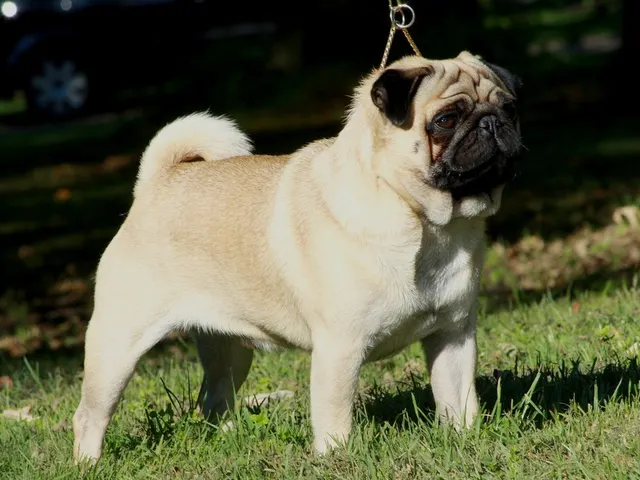
French Bulldog or Pug?
Biggest difference: shedding (low vs. high).
| French Bulldog | Pug | |
|---|---|---|
| Size | Small | Small |
| Weight | 8–14 kg | 6.3–8.1 kg |
| Life expectancy | 10–12 years | 12–15 years |
| Coat | Short | Short |
| Shedding | Low | High |
| Barking | Very low | Low |
| Good with other dogs | Moderate | High |
| Good with cats | Moderate | High |
Who it suits
A good fit if you…
- prefer relaxed walks to long hikes
- live in an apartment
- are getting your first dog
- have children
- want an easy-care coat
- want a quiet dog
- want a cuddly companion
French Bulldog: the downsides
Every breed has a flip side. Before you decide, check that you can live with these:
- Breathing problems
- The short muzzle makes many of these dogs snore, overheat easily and tire quickly; some need airway surgery.
- Breed-typical health risks
- Skin allergies, luxating patella, ear infections. Choose a breeder who screens the parents, and consider health insurance.
- Back problems
- Prone to slipped discs. Keep the dog slim and limit stairs and jumping off furniture.
French Bulldog: puppy price and monthly costs
£1,000 – £3,000 for a puppy from a breeder in the UK (Waggel). From £69 a month in running costs in the UK (PDSA, 2024). Covers food, vet visits, insurance, other costs.
| Country | Puppy from a breeder | Running costs per month |
|---|---|---|
| United Kingdom | £1,000 – £3,000 [5] | from £69 [6] |
| United States | $1,500 – $5,000 [7] | $116 [8] |
| Canada | CA$1,500–8,000 [9] | CA$367 [10] |
| Australia | A$4,000–5,000 [11] | A$210 [12] |
| New Zealand | no data | NZ$100 [13] |
- Set-up costs at the start: £415 – £560 for basic equipment, first vaccinations, wormers and neutering (PDSA, 2024).
- Dog licence in Northern Ireland: £12.50 a year; England, Scotland and Wales have none (nidirect, 2026).
- Dog licence in the US: $5 – $20 a year, set by the city or county (American Kennel Club, 2021).
- Dog licence in Canada: CA$25–60 a year in Toronto, less for a neutered dog (City of Toronto, 2026).
- Dog registration with the council in Australia: A$20–200 a year, depending on the council and whether the dog is desexed (Mozo, 2026).
- Dog registration with the council in New Zealand: NZ$78–182 a year in Auckland, depending on the dog (PetMall NZ, citing Auckland Council, 2026).
- Puppies far below these prices often come without health checks or papers.
Health
Breed-typical health risks
- Brachycephalic airway syndrome [2]
- The short muzzle can cause breathing problems and heat intolerance.
- Intervertebral disc disease [19]
- Prone to back and disc problems. Limit stairs and high jumps.
- Skin allergies [19]
- Prone to itching and skin inflammation.
- Luxating patella [20]
- The kneecap slips out of place, common in small breeds.
- Ear infections [2]
- Floppy ears trap moisture. Check them regularly.
Health tests for the parent dogs
10 health tests appear in the breeding rules for the breed.
- No health test is required for breeding in the UK (The Royal Kennel Club); the table shows what is recommended.
- Needed for a CHIC number in the US (Orthopedic Foundation for Animals): hip X-ray (HD), kneecap check, eye exam, and heart exam.
- No health test is required for breeding in New Zealand (New Zealand Bulldog Club Combined Taskforce); the table shows what is recommended.
| Test | United Kingdom [3] | United States [21] | New Zealand [22] |
|---|---|---|---|
| Hip X-ray (HD)Hip dysplasia | Recommended | Required | Recommended |
| Elbow X-ray (ED)Elbow dysplasia | Recommended | Recommended | not in the rules |
| Spine X-raySpine malformations and disc disease | not in the rules | not in the rules | Recommended |
| Kneecap checkPatella luxation | not in the rules | Required | Recommended |
| Eye examInherited eye disease, by a certified vet ophthalmologist | Recommended | Required | not in the rules |
| Heart examInherited heart disease, by a cardiologist | not in the rules | Required | Recommended |
| Breathing or fitness testBreathing problems from a short muzzle (BOAS) | Recommended | Recommended | Recommended [23] |
| DNA test: CystinuriaCystinuria (cystine bladder stones) | not in the rules | not in the rules | Recommended |
| DNA test: Cystinuria IIICystinuria (cystine bladder stones) | not in the rules | Recommended | not in the rules |
| DNA test: HSF4Hereditary cataract | Recommended | Recommended | not in the rules |
● Required. ○ Recommended: advised, not required. – Not in the rules. The clubs and their rules are in the source list.
United Kingdom: the Royal Kennel Club’s Health Standard requires no test, so every test is ○ recommended.
United States: ● means the test is needed for a CHIC number from the OFA; taking part in CHIC is voluntary.
New Zealand: the kennel club lists these tests as advice and requires none, so every test is ○ recommended.
What to ask the breeder
- Certificates for both parents: hip X-ray (HD), kneecap check, eye exam, and heart exam. A claim that the parents are “health tested” is not enough.
- To see the puppies with their mother, at the breeder’s home.
- The pedigree papers (United Kingdom: Royal Kennel Club registration certificate; Canada: CKC certificate of registration; Australia: Dogs Australia pedigree, issued by the state body; New Zealand: Dogs NZ certificate of registration). [24] [25] [26] [27]
- 8 weeks: the youngest age at which a puppy may leave its mother in the UK, in Canada (Quebec), and in Australia (New South Wales). [28] [29] [30]
- Advice on buying a puppy: The Royal Kennel Club, The Canadian Kennel Club, Dogs Australia, and Dogs New Zealand. [31] [32] [33] [34]
Similar breeds


Sources
- FCI (Fédération Cynologique Internationale): Breed standard No. 101: French Bulldog (2023)
- Canine Medicine and Genetics (O'Neill D.G. et al., VetCompass): French Bulldogs differ to other dogs in the UK in propensity for many common disorders: a VetCompass study (2021)
- The Royal Kennel Club: French Bulldog | Breeds A to Z
- FCI (Fédération Cynologique Internationale): French Bulldog (FCI nomenclature)
- Waggel (UK pet insurer): French Bulldog Breed Guide: Temperament, Training, Health.
- PDSA (People's Dispensary for Sick Animals, UK veterinary charity): The cost of owning a dog (2024). Covers food, vet visits, insurance, other costs.
- PetMD: French Bulldog Dog Breed Health and Care (2023)
- ASPCA (American Society for the Prevention of Cruelty to Animals): Cutting Pet Care Costs (2021). Covers food, vet visits, preventive medicine, insurance, toys and treats, boarding, dog licence, grooming supplies.
- Furkin (Canadian pet insurer): Everything You Need to Know about Frenchies! (2025)
- Pets Plus Us (Canadian pet insurer; figures from OVMA 2024 Cost of Care research): HOW MUCH IS THAT DOGGY? (EN-DOG_PPU_Cost-of-Care_Aug2024_v3.pdf) (2024). Covers food, vet visits, insurance, dog tax, accessories.
- The French Bulldog Club of NSW: Frequently Asked Questions (2022)
- Animal Medicines Australia (survey by Sweeney Research/SNR): Pets in Australia: A national survey of pets and people (Pet Ownership Study 2025) (2025). Covers food, vet visits, insurance, parasite treatment, vet medicines, supplements, grooming, training, accessories, dog walking, boarding, transport, memberships, alternative healthcare.
- Companion Animals New Zealand (NZ Companion Animal Council): Companion Animals in New Zealand 2016 (section 6.3 Dogs, Fig 50) (2016). Covers food, vet visits, dog tax, boarding, equipment, grooming, healthcare products, insurance, training, other costs.
- nidirect (official government website for Northern Ireland): Dog licensing and microchipping (2026)
- American Kennel Club: Are You Financially Prepared for a Puppy? Explore Costs of Owning a Dog (2021)
- City of Toronto: Pet Licensing Fees (2026)
- Mozo: How much does it cost to own a dog or cat in Australia? 2026 (2026)
- PetMall NZ, citing Auckland Council: Auckland Dog Registration 2026–27: Late Fees Now Apply — Full Fee Table (2026)
- The Kennel Club: Breed Health and Conservation Plan: French Bulldog (2020)
- Canine Genetics and Epidemiology (O'Neill D.G. et al., VetCompass): The epidemiology of patellar luxation in dogs attending primary-care veterinary practices in England (2016)
- Orthopedic Foundation for Animals (OFA): CHIC Program Requirements: French Bulldog
- New Zealand Bulldog Club Combined Taskforce (the five NZ Bulldog clubs): French Bulldog Health Testing (FBHS): Bronze, Silver and Gold levels (2019)
- Dogs New Zealand: Respiratory Function Grading Scheme
- The Royal Kennel Club: What should the breeder give me?
- The Canadian Kennel Club: By-Laws (incl. Code of Ethics (2025)
- Dogs Australia: Getting a Dog: Importance of Pedigree Papers
- Dogs New Zealand (New Zealand Kennel Club Inc.): Registration Regulations (Section 4, Reg. 24: Litter Registration Limitations (2026)
- UK Government (legislation.gov.uk): The Animal Welfare (Licensing of Activities Involving Animals) (England) Regulations 2018 (S.I. 2018/486), Schedule 6 (breeding dogs) and Schedule 3 (selling animals as pets) (2018)
- Ministère de l'Agriculture, des Pêcheries et de l'Alimentation du Québec (MAPAQ): Guide d'application du Règlement sur le bien-être et la sécurité des animaux domestiques de compagnie et des équidés (reproduces CQLR c. B-3.1, r. 0.1, art. 36) (2023)
- NSW Department of Primary Industries and Regional Development (DPIRD), State of New South Wales (fact sheet hosted by Dogs NSW): New laws for dog breeders in NSW (fact sheet on the 2024-25 amendments to the Prevention of Cruelty to Animals Act 1979 and Companion Animals Act 1998) (2025)
- The Royal Kennel Club: Questions for the breeder
- The Canadian Kennel Club: Finding an Accountable Breeder
- Dogs Australia: Getting a Dog: Choosing a Breeder
- Dogs New Zealand: How do you go about purchasing a pedigree pure bred dog?
Breeding rules, health sources and breed standards checked October 8, 2026.
Prices as published by the sources; collected October 8, 2026.
Breed traits describe typical tendencies. Every dog is an individual, shaped by genes, upbringing and training.